Omiš History

Share on StumbleUpon Print

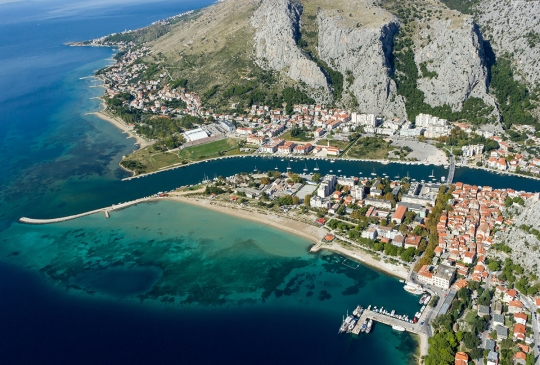
The evidences of proud and turbulent Omis history can be found on every corner of the Omis Riviera. Ancient town of Omis, Omis churches and Omis fortresses are silent stone reminders of the power and the might of famous Omis corsairs. There are several historic names, including Onaion (Oneon), Holm (Hum), Nestos, Oneum (Onaeum), Olmisi, Olmissium, Almivssium, and Almissa. The oldest artefacts that mention Omis date back to Greek and Roman times.

During the Middle Ages Omis was infamous for its corsairs (pirates) whose ships brought fame to them because they were built for attack and fast return into the mouth of the Cetina River, protecting the town from foreign invasion. At a very early date neighbours of the Corsairs of Omis, the highlanders of the Poljica Principality, became their allies, enabling them to harass the sea trade without fear of a sudden attack by land.

In spite of various alliances against Omiš pirates, including the Pope, Venice, Split and Dubrovnik, it was not until 1444 that Venice managed to capture the old pirate town. It happened owing to the approaching Turkish force that made the amber way dangerous, almost impossible. It also meant the decline of the power of the pirates. Deprived of their prey, they lost their strength and the reason for existence. The danger from the Turks became more and more serious. Yet, despite the fact that they conquered the nearby hinterland, Omiš had never fallen into their hands.

Due to permanent threats from the land, as well as from the sea, the existing fortress Starigrad” (Fortica), with military crew in it, and supporting tower Visec” in Cetina River canyon, were not enough for town defence, so, already in Middle Ages, Omis was encircled by walls, fortified with strongholds on the eastern land side, and fortress Peovica” (Mirabella) on the north-western side.

In the Priko neighborhood, on the right bank of the Cetina River, stands the most important building in the city, the pre Romanesque St. Peter's church from the 10th century. This single-naved edifice, with a cupola and apse, was used in the 18th century as a Glagolithic seminary for novice priests.

The Principality of Poljica


Among the many European mediaeval principalities, which after centuries of varying fortune went under, one after another in the aftermath of the French Revolution, the Croatian principality of Poljica (pronounced Pol'yeetsa), with its special brand of rural democracy, occupied a special, indeed unique position.

Its most conspicuous feature was that throughout its long and eventful history, unlike any other of its sister states, it never developed an urban centres on its territory. Its economy almost exclusive depended on animal farming and agriculture. Although its territory included a good stretch of Adriatic coastline, shipping never played a significant part in its economy. Nor was there a concentrated effort to develop fishing.

The reason for this, no doubt, was part due to the absence of good natural harbours, where ships and small craft could shelter from weather, but also partly to the fact that the steep mountain ranges made access to the coast difficult. All the same, there did not seem to be a great deal of interest in the sea.

The territory of the principality - or, as local people often also called it, 'commune' or 'county' - occupied an area of approximately 100 sq. miles of mountainous land just to the south of the town of split, between the rivers Žrnovnica and Cetina, and except for a relatively short stretch of the ragged open terrain to the northwest where its border was not marked by any distinctive natural features, physically it was a fairly enclosed, easily identifiably entity; which is, no doubt, why its name survives to this day as a geographic concept, even though administratively it has long been parcelled out and divided among neighbouring districts.

The dominant physical feature of the area is the Mosor massif, which stretches along the whole length of the principality and whose highest peak rises to nearly 4,500 ft. The physical shape of the massif is such that it divides thee area roughly into three distinct regions: Upper Poljica to the north, between the main Mosor range and Cetina river; Central Poljica, beginning in the west with a valley, almost at sea level, and rising to a high plateau between the main mountain range and the Tatter's southern ridges; and Littoral Poljica, representing a stretch of mostly terraced land, sloping from the Perun, Vršina and Mošnjica hights down to the sea.
 

POLJICA STATUTE


The Poljica Statute is the most important monument of ancient heritage. Besides other relevant facts, it ensured Poljica's independence, sovereignty and unity through many centuries. Fighting continually for dear life, Poljica did not leave any traces of external brilliance-it has no aristocracy, princes, castles, or fortresses. Poljica was left the Statute, which reflects its pride, bravery, sweetness of freedom, and true rural democracy.

The Poljica Statute was written in Poljica's Bosnian alphabet in the ancient church of St. Klement in Sitno.

The oldest preserved manuscript of the Statute originates from 1515 and it is conserved in the Archive of The Croatian Academy of Science and Art, in Zagreb. It represents the third redaction of the Statute, composed around 1485. The second redaction of The Statute originates from 1440 and the original Croatian quotation from it is as follows:

"U ime Gospodina Boga Amen. Statut poljički isući statut iz staroga novi činimo na lita Gospodina Isukrsta 1440."

The term "isući" means excellent, and it is a translation of Latin word "eximius". Therefore, in the language of law, the term "isući" can be explained as an "authentic copy". The first redaction, according to V. Mošin, was written at the end of XI and the beginning of XII century, in the time when the peace agreement called "Pacta conventa" was signed between the Hungarian king Koloman and Croatian representatives (Miroslav Pera, Poljički statut, Književni krug, Split 1988.)

More recent redaction from 1665 has supplemented title (the original Croatian quotation):

"U ime Gospodina Boga Amen. Statut poljički isući statut iz staroga novi činimo na lita Gospodina Isukrsta 1440., a sada pripišujemo na 1665 febrara na 10(I) u Poljici u carkvi svetoga Klimenta pod Sitno".

Every law in the ancient Poljica Principality was unwritten at the beginning, and afterwards it was written in the Poljica Statute using Croatian cyrillic script (bosančica). That process was predominantly done by glagolitic priests from the church of St Clement. That church had great wealth in lands, and it could keep scribes and buy paper, which was very expensive in those days.

During Turk domination, glagolitic priests escaped from Poljica and found relief on the island of Brač, in the Blaca desert, in the famous glagolitic monastery where the last priest was don Niko Miličević.
 

Poljica Today


Today, the following villages represent the area that historically belonged to the Poljica Principality (Poljička Republika):

Omiš municipality: Gata, Čišla, Ostrvica, Zvečanje, Smolonje, Studenci, Kostanje, Podgrađe, Kreševo, Blato na Cetini, Seoca, Trnbusi, Dolac gornji, Dolac donji, Srijane, Nova sela, Putišić, Dubrava, Tugare, Naklice.

Šestanovac municipality: Katuni, Šestanovac.

Zadvarje municipality: Zadvarje, Žeževica, Grabovac, Dundići.

Dugi Rat municipality: Duće, Dugi Rat, Jesenice.

Back to Top